ශ්රී ලංකා තානාපති කාර්යාලය, වොෂින්ටන් ඩී.සී., ඇමරිකා එක්සත් ජනපදය
இலங்கைத் தூதரகம், வொஷிங்டன் டி.சி, ஐக்கிய அமெரிக்கா
Embassy of Sri Lanka, Washington D.C.,United States

Sri Lanka - US Bilateral Trade Relations
The US–Sri Lanka economic partnership spans more than a century. The United States remains Sri Lanka's single largest single-country export destination, accounting for approximately 24% of total exports in 2025.
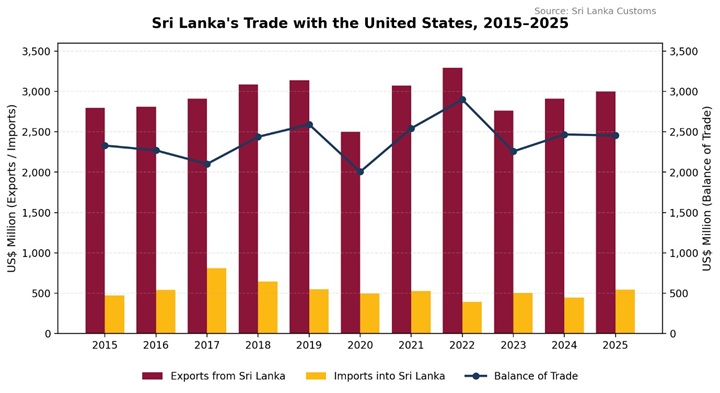
Over the past decade, Sri Lankan exports to the United States have fluctuated, peaking at US$ 3,291 million in 2022 . In 2025, exports to the US totalled US$ 3 billion, while imports from the US reached US$ 544 million — bringing total bilateral trade turnover to US$ 3,544 million.
Sri Lanka's Trade with the US (US$ million)
| Year | Exports from Sri Lanka | Imports into Sri Lanka | Balance of Trade |
| 2015 | 2,800 | 471 | 2,330 |
| 2016 | 2,810 | 540 | 2,270 |
| 2017 | 2,912 | 811 | 2,101 |
| 2018 | 3,084 | 645 | 2,438 |
| 2019 | 3,141 | 549 | 2,592 |
| 2020 | 2,499 | 495 | 2,004 |
| 2021 | 3,071 | 528 | 2,543 |
| 2022 | 3,291 | 392 | 2,900 |
| 2023 | 2,762 | 505 | 2,257 |
| 2024 | 2,910 | 443 | 2,467 |
| 2025 | 2,999 | 544 | 2,455 |
Source: Sri Lanka Customs
Trade and Investment Framework Agreement (TIFA)
The Trade and Investment Framework Agreement (TIFA), signed on 25 July 2002, provides the principal framework for regular US–Sri Lanka dialogue on trade and investment matters.
The 14th TIFA Council Meeting was held in Colombo on 18 September 2023, marking the 75th anniversary of bilateral relations. Discussions covered market access, the investment climate, labor law reforms, anti-corruption measures, intellectual property protection, and cooperation in technology transfer, the digital economy, floriculture, boat building, and coconut research. The two governments continue to engage through the TIFA mechanism.
Bilateral Air Transport Agreement
Signed on 11 June 2002 and entered into force on 18 November 2002, this Open Skies Agreement provides a legal framework for unrestricted capacity and frequencies for airlines of both countries, including liberalized codesharing and charter arrangements. It covers both passenger and cargo services and provides for cooperation on air traffic security and safety, benefiting travellers, the business community, and the Sri Lankan diaspora in the United States.
Sri Lanka's Trade Policy
Since the trade liberalization initiatives of the late 1970s, Sri Lanka has developed one of the most liberalized trade regimes in South Asia. The foreign trade policy continues to pursue further liberalization, aiming to integrate Sri Lanka into the global economy while balancing the interests of domestic industry through targeted measures.
In line with the national tariff policy, Sri Lanka's tariff on imported goods have been structured into a simplified four-band system of 0%, 10%, 20% and 30% with effect from 01 April 2026.
There are minimal non-tariff measures such as licensing or quota restrictions on imports or exports, and the government's tariff policy aims to provide a transparent, predictable framework for all trade stakeholders.
Sri Lanka extends preferential tariff benefits under the following trade agreements:
- Indo-Sri Lanka Free Trade Agreement (ISFTA)
- Pakistan-Sri Lanka Free Trade Agreement (PSFTA)
- South Asian Free Trade Area (SAFTA)
- Asia-Pacific Trade Agreement (APTA)
- Singapore - Sri Lanka Free Trade Agreement (SSLFTA)
- Sri Lanka – Thailand Free Trade Agreement (SLTFTA)
As a founding member of the GATT and WTO, Sri Lanka remains committed to a rules-based multilateral trading system that ensures transparency and predictability for the international business community.
Key Sri Lankan Export Products to the U.S. Market
- Apparel and textiles
- Tea
- Rubber and rubber-based products
- Coconut and coconut-based products
- Activated Carbon
- Graphite based products
- Spices
- Gems and jewellery
- Boats and ships
Sri Lanka - Mexico Trade Relations
Prior to the establishment of formal diplomatic relations, Sri Lanka and Mexico had already developed trade connections. Historically, Ceylon cinnamon reached Mexican markets via Manila (Spanish East Indies) Galleon trade route connecting Ceylon and the Philippines to Acapulco (New Spain/Mexico) during the 16th and 17th centuries. In Mexican cuisine, Ceylon cinnamon is known as canela or ‘true’ cinnamon.
The economic significance of this relationship increased in the 1970s, particularly as both nations became active participants in the politics of the Global South and the Non-Aligned Movement. During the visit of Mexican President Luis Echeverría to Colombo, a Protocol on Economic Cooperation was signed on 25 July 1975 . This protocol indicated that cinnamon and rubber were the predominant products at that time, prompting both parties to seek diversification beyond these commodities.
Since the year 2000, there has been a gradual diversification of exports, including garments, rubber products, tea, cinnamon, and other agricultural products from Sri Lanka, while Mexico exported smaller quantities of manufactured and chemical products.
Contemporary trade between the two countries consistently results in a positive trade balance for Sri Lanka. In 2025, Sri Lanka exported products valued at US$189 million to Mexico, including cinnamon (US$ 90 million), coco peat/fiber pith/moulded products (US$ 22 million), men's and women's garments (US$ 48 million), and rubber tyres and tubes (US$ 7 million). Sri Lanka imports chemicals, pharmaceuticals, computers, and electrical equipment from Mexico, in small quantities.
Sri Lanka - Trinidad & Tobago Trade Relations
Sri Lanka and Trinidad and Tobago enjoy friendly economic relations, with opportunities to further expand bilateral trade, investment and business cooperation. Sri Lanka continues to promote exports and private-sector partnerships, particularly in apparel, tea, spices, rubber products and other value-added goods, while exploring new avenues for mutually beneficial economic engagement.